Forty-one percent of Greater Lowell Nonprofits Unable to Meet Community Demand, New Survey Shows
Federal cuts, state budget pressures, and private funding competition create perfect storm for nonprofits serving vulnerable populations
Nearly half of Greater Lowell’s nonprofits report they cannot meet existing community needs with available resources, according to a new survey released by the Greater Lowell Community Foundation. The finding underscores an urgent crisis facing the region’s nonprofit sector as federal funding shrinks, state budgets tighten, and competition for private donations intensifies.
The Summer 2026 survey of 75 nonprofit organizations reveals a sector under acute pressure, with nearly three-quarters reporting cautious to very concerned outlooks for the coming year.
BY THE NUMBERS:
41% | Cannot meet existing community demand
85% | Report foundation/private grant funding more competitive than ever
75% | Express cautious to very concerned outlook for next 12 months
52% | Report increased staff workload/stress
49% | Struggling with increased administrative burden
“These numbers tell a story about the limits of nonprofit resilience,” shared Jennifer Aradhya, VP Marketing, Programs & Strategy, GLCF. “Organizations are doing everything right—applying for grants, building individual donor programs, forming partnerships, stretching budgets. But they’re hitting a ceiling. When demand is rising and every funding source is tightening simultaneously, no amount of innovation can fill the gap.”
A Multi-Source Funding Crisis
The challenge facing Greater Lowell nonprofits extends far beyond federal cuts:
- Federal Funding: One-third (33%) experienced direct cuts. Among those affected, the average loss was 10-25% of budget.
- State Funding: Thirty-one percent report state funding decreased, as states absorb federal reductions and reallocate budgets.
- Private Funding: Competition for foundation grants reached record levels. Eighty-five percent report private funding more competitive; 40% succeed on less than 25% of applications.
- Individual Giving: Thirty-one percent report decline in individual donations, while 45% see stable giving.
- The result: a margin squeeze that leaves nonprofits unable to maintain current service levels.
Vulnerable Populations Losing Services
The consequences are real. Nonprofits report the following populations are experiencing the most severe service reductions:
- Low-income families: 52% of respondents
• Children and youth: 49% of respondents
• Immigrants and undocumented individuals: 27% of respondents
• Seniors: 25% of respondents
Service reductions include program eliminations, reduced client capacity, service delivery delays, and deferred facility maintenance. Nineteen percent report eliminating programs entirely.
The Nonprofit Workforce at Breaking Point
Funding pressures are taking a toll on nonprofit staff:
- 52% report increased staff workload and stress
• 21% have implemented hiring freezes
• 29% delayed wage increases
• 13% experienced staff turnover
Over half report increased workload despite reduced service capacity—a recipe for burnout and turnover in a sector that relies on mission-driven staff.
GLCF’s Response: Strategic Support to Close the Gap
The Greater Lowell Community Foundation is responding to these urgent findings with expanded and refocused grantmaking:
- Unrestricted operating support to give nonprofits flexibility to redirect resources to the greatest needs
- Priority funding for smaller local organizations serving low-income families, children, immigrants, and other vulnerable populations
- Convening nonprofits to share strategies and coordinate regional response
- Trust-based funding with streamlined reporting
“The data is clear: nonprofits need flexible, sustainable funding and coordinated funder support,” said Jennifer Aradhya, VP Marketing, Programs & Strategy, GLCF. “We’re moving rapidly to expand unrestricted operating support and build partnerships with other funders to address this critical need. Every day we wait, more organizations are forced to cut services to people who depend on them.”
About the Survey
The Summer 2026 State and Federal Funding Impact Survey collected responses from 75 nonprofit organizations across all sectors and budget sizes serving Greater Lowell and surrounding communities. Respondents included organizations in education/youth development, food security, social services, housing, healthcare, arts/culture, environmental services, and more.
How You Can Help: Direct Support for Our Nonprofit Partners
While the Greater Lowell Community Foundation continues to expand unrestricted grantmaking and coordinate funder response to this crisis, immediate support is urgently needed. GLCF’s Resilience and Care Fund provides rapid-response grants to nonprofits serving vulnerable populations facing urgent basic human needs—food, housing, fuel assistance, immigrant support, health and mental health services, and more.
GLCF is planning a year-end distribution to nonprofit partners, ensuring that funds raised now will reach organizations serving our most vulnerable residents at a critical moment. The more we raise, the more we can distribute.
“While these funds will be quickly distributed to address immediate needs, there is more to do,” said Jay Linnehan, President and CEO of the Greater Lowell Community Foundation. “I encourage you to help grow our community’s resilience by adding your own contribution. Every gift, no matter the size, strengthens the safety net that catches our neighbors when they fall—and will be distributed directly to nonprofit partners working on the front lines this year.” To contribute to GLCF’s Resilience and Care Fund, visit: glcfoundation.info/resilience.
About Greater Lowell Community Foundation
Established in 1997, the Greater Lowell Community Foundation (GLCF) is a philanthropic organization comprised of more than 500 funds dedicated to improving the quality of life in 21 neighboring cities and towns. With financial assets of over $77 million, GLCF annually awards grants and scholarships to hundreds of worthy nonprofits and students. It is powered by the winning combination of donor-directed giving, personal attention from Foundation staff, and an in-depth understanding of local needs. The generosity of our donors has enabled the Community Foundation to award more than $55 million to the Greater Lowell community.
###
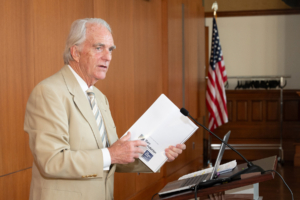
CAPTION: GLCF President and CEO Jay Linnehan at the 2026 Annual Meeting in June. GLCF released findings from a follow up survey to determine how federal, state, and private funding sources are shifting for Greater Lowell nonprofits.